
Reviewed · CROSS-BORDER BALKANS TRIPS
Small Group Tour; Gems of Albania, Kosovo & N. Macedonia
The most interesting part of this three-country Balkan route is its range. In eight days, you move from Kruja’s medieval bazaar to Kosovo’s mosques and monasteries, then on to Ohrid’s lakeside churches, Berat’s castle, and Tirana’s Cold War bunker. It is a fast-moving cultural trip, not a slow holiday.
I like the maximum group size of 10, which should make border crossings, short walks, and questions easier to manage. I also like the mix of places: Matka Canyon and Lake Ohrid break up the long run of castles, museums, and old towns. The main consideration is pace. Several days cover large distances, and the published schedule mentions Gjirokastra, Butrint, and the Blue Eye in the overview, but does not place them in the eight-day daily program.
Key points at a glance
- Three countries in eight days: Albania, Kosovo, and North Macedonia are linked by private transport and a single tour leader.
- Four UNESCO World Heritage sites are promised: Ohrid, Berat, Deçan Monastery, and the fourth site should be confirmed before booking because the daily schedule does not clearly identify all four.
- Small-group format: The group can include up to 10 people, with hotel pickup and drop-off in Tirana.
- The strongest scenic stops: Matka Canyon, Lake Ohrid, St. Naum, Drilon National Park, and the views from Kruja and Rozafa castles.
- Shared three-star rooms: Breakfast and accommodation are included, while lunch, dinner, drinks, and snacks are extra.
- Good value for independent visitors: Private transport and cross-border planning save time, but the $2,361.02 price is a serious commitment.
Three countries, one fast-moving road trip
This experience gives you a useful first look at a part of Europe that is still less familiar to many North American visitors. Albania supplies the castles, communist-era story, and mountain towns. Kosovo adds Ottoman streets, religious landmarks, and a young capital. North Macedonia brings Lake Ohrid, Orthodox sites, and Matka Canyon.
The route is built around road travel. That matters because public transport between many of these places is limited or awkward, especially when you want to cross borders and visit several historic sites in one week. The private vehicle removes much of that planning burden.
You should still expect some long stretches in the vehicle. The published stop times are often short, sometimes only 30 minutes. This works well if you want a broad introduction, but less well if you prefer to linger in museums, shop slowly, or take long walks.
The operator includes a professional tour leader rather than separate local guides at every stop. That can be a strength because one person carries the story of the whole journey from country to country. Named leaders connected with this operator include Ardit, Eltoni, Sokol, Lecko, Gizeem, and Nik, though your assigned guide is not specified in advance.
More cross-border Balkan runs:
- Semi-Private Tour of North Macedonia: Ohrid & Struga from Tirana
★ 5.0 · 170 reviews - North Macedonia: Ohrid & Saint Naum Day Tour from Tirana
★ 5.0 · 151 reviews - Day Tour of Kosovo from Tirana, Pristina and Prizren
★ 5.0 · 93 reviews
Day 1: Kruja’s bazaar and Skanderbeg’s castle
Your first morning begins with pickup at your Tirana hotel, or at the operator’s office in the Twin Towers complex at 9:00 a.m. Kruja is the opening stop, a hill town tied to Albania’s resistance against Ottoman expansion in the 15th century.
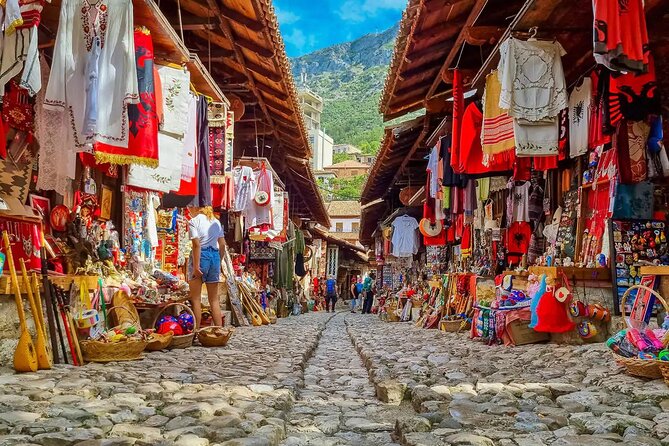
The Medieval Old Bazaar is the most enjoyable part of the visit for many people who like browsing. Its narrow lane and wooden-fronted shops sell carpets, jewelry, and handmade souvenirs. This is a better place to look for Albanian crafts than a modern shopping street, but allow yourself some self-control. The schedule gives you about an hour.
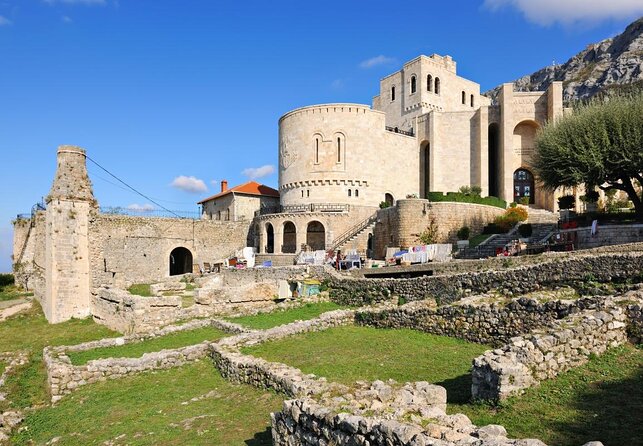
Kruja Castle sits above town on rocky ground. The tour leader is expected to point out lesser-used paths associated with the castle’s defenses. The setting is more important than any single surviving wall: from here, you get a sense of why the site mattered.
You have about 30 minutes of free time for lunch, shopping, or wandering. Lunch is not included, so budget separately for traditional food throughout the trip. The short opening day gives you a gentle introduction, though the castle terrain may feel demanding if you have trouble with uneven paths or slopes.
Day 2: Shkodra and a Kosovo border crossing
Shkodra is one of Albania’s oldest cities and has long been a meeting point for different cultures. Its Venetian influence gives parts of the city a different feel from central and southern Albania. If your visit falls in February, the schedule notes the possibility of seeing the city’s carnival, known for handmade Venetian-style masks.
Rozafa Castle is the main stop. Its hilltop position gives wide views over Lake Shkodra and the rivers that run toward the Adriatic. Thirty minutes is enough for the basic viewpoint, but not for a leisurely exploration of every corner.
The route then crosses into Kosovo for Deçan Monastery. The monastery is known for its pale exterior and its 14th-century frescoes, which helped earn UNESCO recognition in 2004. Orthodox monks still live there and produce food such as cheese.
This is one of the route’s most valuable cultural shifts. You are not only looking at an old building. You are seeing a living religious site, and the visit adds a religious and artistic layer to a journey that otherwise leans heavily toward castles and urban monuments.
Border crossings are part of the experience, but they also make timing less predictable. The published schedule does not explain document requirements or waiting times, so confirm current entry rules for all three countries before departure.
Day 3: Prizren, Ottoman streets, and a hilltop view
Prizren is one of the most appealing urban stops on the route. The river runs through the old town, stone bridges connect its banks, and medieval houses line the streets. You can also look for local filigree work, a traditional craft involving fine metal threads.
Sinan Pasha Mosque is the main religious visit. Its colored decoration and patterned interior offer a clear example of Ottoman influence in Kosovo. Dress and photography rules at religious sites can change, so follow your leader’s instructions.
The climb to Kalaja Fortress gives you a broad view over Prizren. The stop is only about 30 minutes, which means this is a quick look rather than a full fortress hike. Wear shoes that handle uneven surfaces, especially if the weather is wet.
The best use of free time here is simple: walk beside the river, study the old houses, and save room for local food. Prizren is a place where the street scene does as much work as the formal attractions. If you enjoy cafés, bridges, small workshops, and mixed religious architecture, this may be one of your favorite days.
A few more Tirana half-days to weigh up
- Hike Gamti Mountain with Bovilla lake view & canyon- From Tirana
★ 5.0 · 1,280 reviews - Berat city UNESCO tour, the Castle & Belshi lake- From Tirana
★ 5.0 · 804 reviews - Walking Tour of Tirana
★ 5.0 · 646 reviews - Kruja castle, the old Bazaar & Sarisalltik- Departure from Tirana
★ 5.0 · 592 reviews
Day 4: Pristina to Skopje
Pristina offers a brief look at Kosovo’s modern national identity. The Newborn monument marks independence and gives the capital a youthful public symbol. You then walk toward Mother Teresa Square, with Skanderbeg Square and its statue nearby.
The stop is short, only around 30 minutes in the published plan. You will get orientation, a coffee possibility, and a sense of the central boulevard, but not a detailed tour of the capital.
Skopje introduces another change in tone. The city brings together European, Ottoman, and other influences, with the Stone Bridge linking the newer center to the Old Bazaar. The central Alexander the Great statue and the Art Bridge, lined with statues of artists and musicians, reflect the city’s grand public style.
The Old Bazaar gets about an hour. This is where the city feels most connected to its Ottoman past, with lanes, shops, and older buildings mixed into modern daily life. Skopje is visually busy, and some people may find the monumental center too theatrical. I would treat it as a city of contrasts rather than expect a uniform old town.
Day 5: Matka Canyon and Lake Ohrid
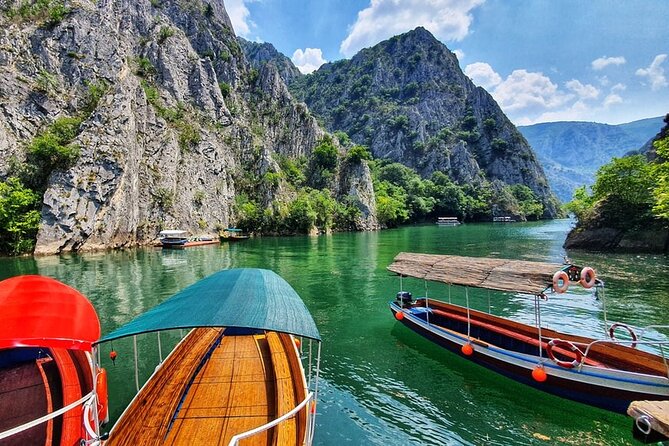
Matka Canyon is a welcome outdoor break after several city visits. It lies close to Skopje, yet the canyon feels far removed from the capital. The included boat trip is the centerpiece, with turquoise water, steep rock, caves, medieval remains, and hiking routes nearby.
The schedule allows about an hour. That is enough for a boat ride and a quick look, but not for a serious hike, cave visit, swim, and relaxed meal. If you want more time outdoors, ask the operator if the route can be adjusted before you book.
From Matka, you continue toward Ohrid, one of North Macedonia’s major cultural destinations. Lake Ohrid and the city have UNESCO recognition, and the area has a long record of settlement. The lake was known to the Romans as Lyhnidas, or the Light Lake.
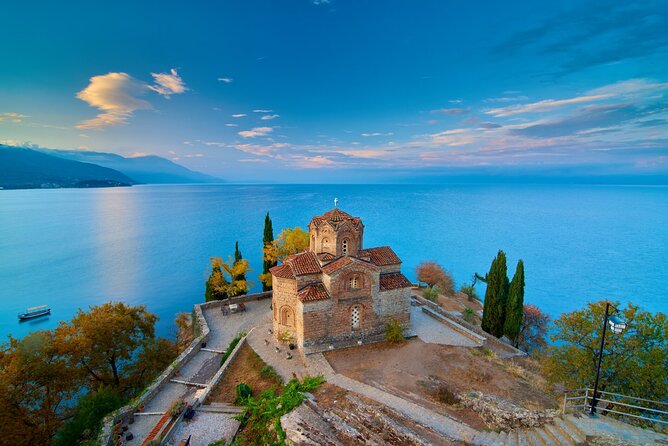
Ohrid’s appeal comes from the meeting of water, hills, churches, and old streets. The schedule includes viewpoints connected with St. John, the church of St. Nicholas, and the Halveti Hayati Tekke mosque. That combination matters. You are seeing Orthodox and Islamic landmarks in the same historic setting, not just ticking off one famous church.
The pace again is brisk. One hour gives you a taste of the city, but Ohrid rewards an evening stroll if your overnight arrangements leave room for one.
Day 6: St. Naum, Galichitsa, and Drilon
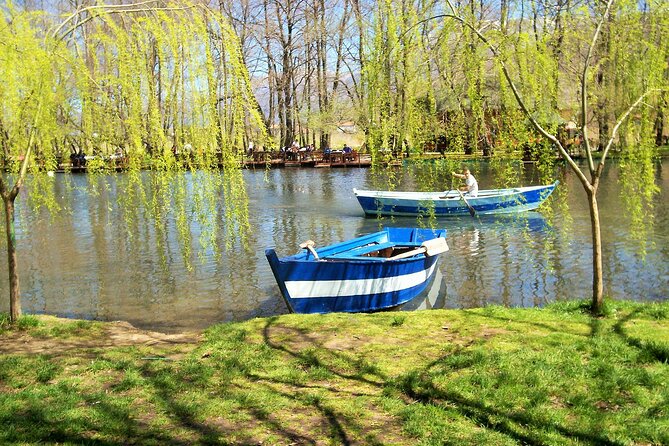
The road to St. Naum passes through Galichitsa National Park, between Lake Ohrid, Lake Prespa, and the Albanian border. The mountain views are a major part of this day, and the drive itself helps explain the region’s geography.
St. Naum Monastery sits beside the source of the Crni Drim River. Clear spring water reflects the surrounding greenery and mountain peaks, making this one of the most peaceful stops on the route. The monastery is also within a strictly protected area of the national park.
After crossing back into Albania, you visit Drilon National Park and the village of Tushemisht. Drilon is known for its small lake, channels, greenery, and quiet setting. It is also a useful food stop because the area is associated with fish dishes, especially baked speckled trout, called Koran in Albanian.
This is one of the trip’s best balances between scenery and local life. You get a protected natural area, a village setting, and a chance to try regional food. Meals are not included, so this is a good place to plan your own lunch rather than assume it is covered.
The day ends with a drive toward Berat. The schedule does not provide drive times, so expect this to be another road-heavy day.
Day 7: Berat, the town of 1,001 windows
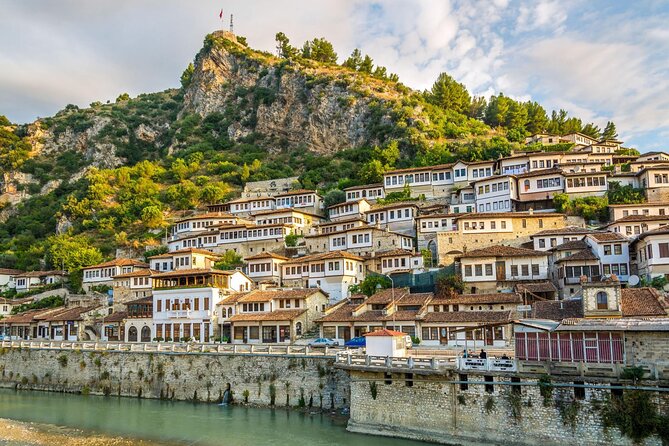
Berat is one of Albania’s strongest historic towns. Its white houses climb the hills in layers, creating the nickname town of 1,001 windows. The effect is best understood from across the river, where the old homes appear stacked above one another.
Berat Castle is more than a ruin. People still live within its walls, alongside old churches, mosques, and museum spaces. The stone lanes are steep and uneven, but that is part of the charm. Take your time with the views and do not treat the castle as a quick photo stop.
The National Iconographic Museum Onufri focuses on the painter known for church art across the Balkans. His distinctive reddish color is a useful detail to listen for because it gives the collection a concrete artistic identity.
You also visit the Gorica neighborhood and its old stone bridge. Berat works well on this route because it brings together architecture, religion, art, and ordinary residential life in one compact setting.
The published visit is divided into several 30-minute stops. That keeps the group moving, but it may leave you wishing for more time in the castle or museum. If you are especially interested in Byzantine art, ask how much independent time is available.
Day 8: Tirana and Albania’s communist past
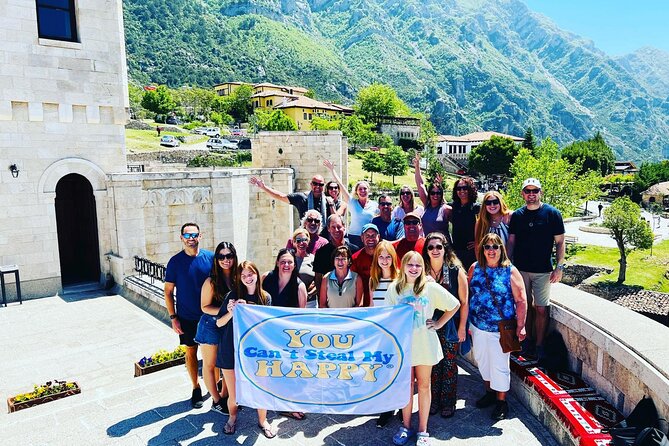
The final day returns to Tirana. The capital has Ottoman, Italian, and communist-era buildings, along with newer cafés and public spaces. It is less polished than some European capitals, but that mix is exactly what makes it worth walking.
Skanderbeg Square is the natural starting point. The National Museum, Opera House, Bank of Albania, Ethem Beu Mosque, and Skanderbeg statue surround the square. The visit is short, so use the walk for orientation rather than trying to enter every building.
BUNK’ART 2 is the most distinctive stop. The museum occupies a former nuclear bunker built for Enver Hoxha and senior communist officials. Its exhibits focus on the communist army and the daily lives of Albanians under the regime.
This visit gives needed context to the country’s recent past. Albania’s isolation and communist rule shaped its buildings, families, and public life, and the bunker makes that period physical rather than abstract. Some displays may be heavy in tone, so allow yourself time to process the material.
The final walk takes you along Rruga Murat Toptani, a pedestrian area near Tirana Castle, then into Blloku. Once associated with the communist leadership, Blloku is now known for restaurants, bars, street food, and modern city life. It is a fitting finish: Albania’s past is still visible, but the capital is clearly looking forward.
The UNESCO promise needs a closer look
The experience advertises four UNESCO World Heritage sites. The daily schedule clearly includes Ohrid, Berat, and Deçan Monastery. It also refers to UNESCO recognition for Lake Ohrid and Ohrid city as a shared cultural and natural site, so the exact count may depend on how the operator classifies the stops.
The overview also names Gjirokastra, Butrint National Park, and the Blue Eye spring. Those places do not appear in the eight daily sections supplied for this tour. This is the single most important point to clarify before paying.
If those destinations are essential to you, ask for written confirmation that they are included on your departure. Do not assume that a broad summary guarantees every named attraction will appear in the final road plan.
What the $2,361.02 price really covers
At $2,361.02 per person, the price works out to roughly $295 per day. That is not a budget tour, but the comparison with independent travel is not simply the room price.
You are paying for private transportation, petrol, road taxes, international car insurance, tourist taxes, a professional tour leader, hotel pickup and drop-off in Tirana, accommodation, and breakfast. Cross-border routing across Albania, Kosovo, and North Macedonia would take substantial planning on your own.
Accommodation is based on shared double, twin, triple, or quadruple occupancy in three-star hotels. A single room costs an additional 45 euros per night, or 315 euros for seven nights, assuming all seven overnights use the stated supplement.
Lunch, dinner, drinks, snacks, souvenirs, and personal spending are extra. I would build a separate food budget and ask exactly which attraction admissions are included, since individual stop descriptions list some tickets as included while others are free.
The small group adds value. With a maximum of 10 people, you should have a better chance to hear explanations and get help at borders or hotels than on a large coach tour. The tradeoff is that fixed group timing gives you less freedom than a fully private trip.
Who should book this journey?
This is a good fit if you want to see a lot in one week and prefer having transport and hotels arranged. It suits people who enjoy history, religious art, old towns, mountain views, and trying local food without planning every road connection.
It is less suitable if you want long hikes, slow museum visits, beach time, or several free evenings. The 30-minute stops are useful for orientation, but they are not enough for deep exploration.
The tour also suits couples and families who value organization. One family described the hotels and guide Eltoni as especially good, while other departures included leaders such as Ardit, Sokol, and Lecko. The most consistent strength is the guide’s role in explaining the history and handling the practical details.
Practical advice before you go
Confirm the exact route, especially the promised Gjirokastra, Butrint, Blue Eye, and fourth UNESCO site. Ask how much free time you will have in Ohrid, Berat, and Prizren, since those towns reward independent walking.
Pack comfortable shoes for castle hills, stone lanes, and uneven paths. Bring room in your budget for meals and snacks, and remember that border crossings can alter the day’s timing.
The tour is non-refundable and cannot be changed after booking, so verify the dates, room arrangement, pickup plan, and border route first. Most people can participate, but the amount of walking and the rough surfaces at castles and old towns are worth considering.
Should you book it?
Book this tour if your priority is a well-organized first look at three Balkan countries rather than a slow stay in one place. The route’s best moments are the contrast between Kruja, Prizren, Ohrid, Berat, and Tirana, plus the natural stops at Matka, St. Naum, and Drilon.
I would book only after confirming the missing attractions in writing. If the final route matches your expectations, the private transport, small group, breakfasts, and strong guide-centered format make the price easier to justify. If you want flexibility or the full southern Albania circuit, a private custom trip may be the better choice.
FAQ
How long is the tour?
The experience lasts approximately eight days and ends back at the meeting point in Tirana.
Which countries does the tour visit?
The route visits Albania, Kosovo, and North Macedonia.
What is the maximum group size?
The tour has a maximum of 10 participants.
Is hotel pickup available?
Yes. Hotel pickup and hotel drop-off in Tirana are included. The listed meeting point is the Choose Balkans office at the Twin Towers, Tower 2, in Tirana, with a 9:00 a.m. start time.
What accommodation is included?
Accommodation with breakfast is included for all overnight stays, based on double, twin, triple, or quadruple occupancy in three-star hotels.
Is a single room available?
Yes. Single occupancy is available for an additional 45 euros per night per person in a three-star hotel.
Are meals included?
Breakfast is included. Lunches, dinners, drinks, snacks, souvenirs, and personal spending are not included.
Are Gjirokastra, Butrint National Park, and the Blue Eye included?
They are named in the broad tour description, but they are not assigned to a day in the eight-day schedule provided. Confirm their inclusion with the operator before booking.
Just added around Tirana
- Apollonia and Berat UNESCO tour from Tirana★ 5.0 · 3 reviews
- UNESCO heritage in Albania – 4 days★ 5.0 · 3 reviews
- Private Transfers from Tirana International Airport to Sarandë★ 4.5 · 3 reviews
- Transfers Tirana Airport – Sarande – Ksamil – Airport Tirana★ 4.5 · 3 reviews
- Berat 4×4 Off-Road and Vineyard Wine Tasting★ 5.0 · 3 reviews
- Cultural Tour in Tirana including House of Leaves★ 5.0 · 3 reviews
- N. Macedonia &Kosovo; Semi – Private Tour; Tour Leader & Car★ 4.8 · 3 reviews
- SOTIRA WATERFALL HIKING/TREKKING from Berat by 1001 Albanian Adventures★ 5.0 · 3 reviews
Cross-Border Balkans Trips, compared.
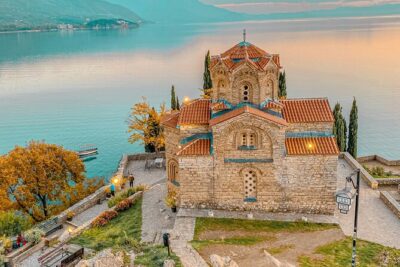
Semi-Private Tour of North Macedonia: Ohrid & Struga from Tirana
Read our review →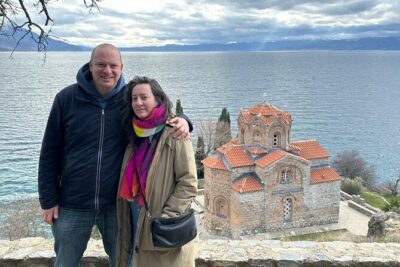
North Macedonia: Ohrid & Saint Naum Day Tour from Tirana
Read our review →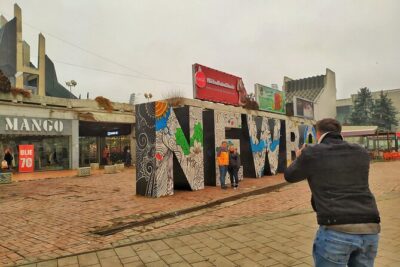
Day Tour of Kosovo from Tirana, Pristina and Prizren
Read our review →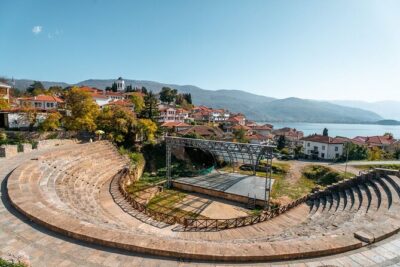
Ohrid – North Macedonia Full Day Tour from Tirana & Durres/Golem
Read our review →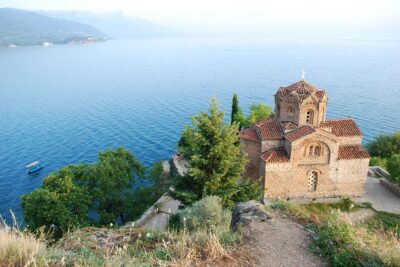
Private Ohrid Day Tour and Authentic Village from Tirana & Durres
Read our review →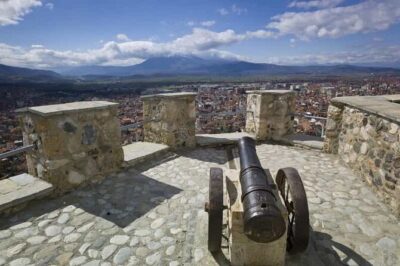
From Tirana/Durres/Golem: Prizren and Prishtina Full-Day Tour
Read our review →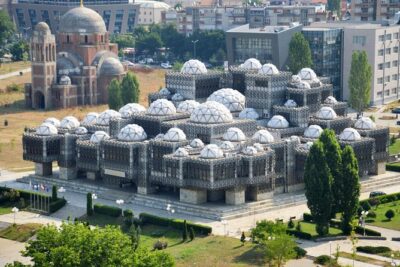
Best of Kosovo Day Tour – Pristina & Prizren from Tirana & Durres
Read our review →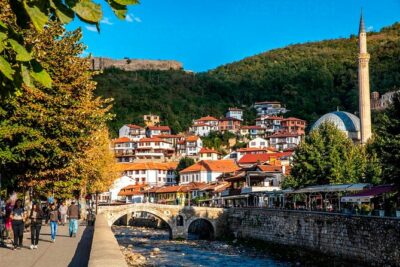
Browse the lists this tour appears in