
Reviewed · TIRANA TOURS
Cultural Tour in Tirana including House of Leaves
Tirana’s past comes into sharp focus at the House of Leaves, a former secret police headquarters where you see how communist Albania watched, controlled, and punished its own people. That serious hour gives this tour more weight than a simple city walk.
I like the mix of major sights and less obvious stops, especially the Sali Shijaku Villa and the old Tanners’ Bridge. I also like the small maximum group of 10, which should make it easier to ask questions and keep the walk personal.
The main drawback is the ambitious route. Four hours covers a lot of ground, and some stops may be closed or altered, so you should book this for broad city orientation rather than a slow, detailed visit to every site.
Key points to know before booking
- House of Leaves is the emotional center: Allow time for its exhibits on surveillance and life under Albania’s communist state.
- The route mixes famous and local sights: Skanderbeg Square, the Pyramid, St. Paul’s Cathedral, New Bazaar, and Sali Shijaku Villa all appear alongside smaller landmarks.
- The art stop is unusually personal: Sali Shijaku’s 300-year-old villa also served as the painter’s home and workplace.
- The group is capped at 10 people: This is a useful size for a walking tour with several cultural stops.
- The price is $58.18 per person: That is fair if the included admissions and four hours of guiding matter to you.
- The tour begins and ends at Skanderbeg Square: Plan your day around a 9 a.m. to 5 p.m. operating window.
Why House of Leaves gives this Tirana tour its purpose
Many Tirana sightseeing walks focus on Ottoman traces, grand squares, and bright cafes. This one gives you something harder and more valuable: a clear look at how ordinary Albanians lived under communist rule.
The House of Leaves occupies a former secret police headquarters. Its museum explains the tools and methods used to monitor people, collect information, and target those considered a threat to the state. You are not simply looking at an old building. You are seeing the machinery of fear inside a place that once helped run it.
Plan on about an hour here. That is enough time for a useful introduction, though visitors who read every display closely may want more. The subject is serious, and the museum can shape how you understand later stops, especially the Pyramid of Tirana and the Postbllok memorial.
I consider this the strongest reason to choose this particular cultural tour. The museum connects architecture, politics, and personal experience in a way a quick exterior visit cannot. It also gives your guide a chance to explain Albania’s communist period in human terms rather than as a list of dates.
More Historical Tours in Tirana:
- Tirana Walking Tour: History, Culture &Gems by a Passionate Guide
★ 5.0 · 52 reviews - Semi – Private Tour at Cape of Rodon; Hidden Beaches & History
★ 5.0 · 46 reviews - Walking tour of Tirana; History & Culture
★ 5.0 · 37 reviews
Starting at Skanderbeg Square
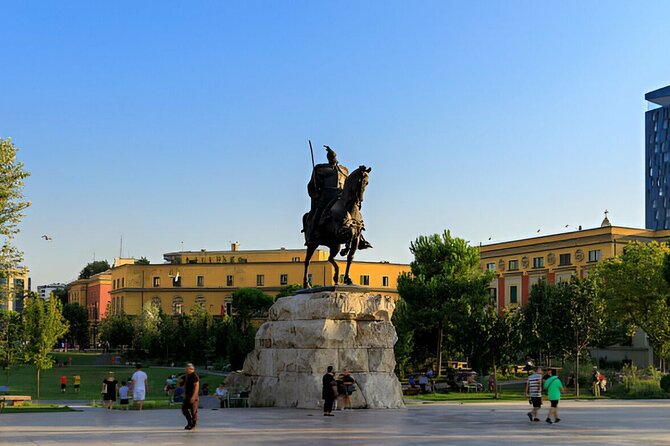
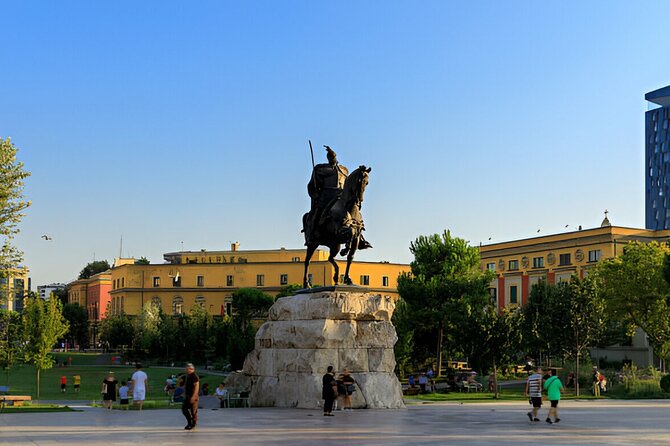
The tour begins at Skanderbeg Square, the natural place to get your bearings in central Tirana. The large plaza takes its name from Gjergj Kastrioti, Albania’s national hero, better known as Skanderbeg.
His statue occupies the middle of the square. Around it, you will see neo-Renaissance buildings, the Opera and Ballet Theater, the National Library, and government buildings. The square is broad and open, so it offers an easy introduction to the city’s civic center.
The scheduled visit here is about 20 minutes. That is enough for an explanation of the statue and surrounding buildings, plus a few photographs. It is not meant to be a full architectural study.
I like beginning here because the square gives you a visual map of Tirana. From this point, the tour moves into religious buildings, museums, neighborhoods, and reminders of the communist years. You start with national identity before moving into the more difficult parts of the country’s story.
Mosques, cathedrals, and the Clock Tower
The tour includes the Et’hem Bey Mosque, known for its detailed frescoes and its place in Albania’s return to religious freedom and democracy. It is a quieter counterpoint to the scale of Skanderbeg Square.
The mosque is important not only for its decoration but also for what it represents. Albania’s communist government severely restricted religious practice, making the reopening of religious life a major part of the country’s modern story. Your guide can connect the building to that wider change.
The overview also includes an ascent of Tirana’s Clock Tower for city views. From above, you can look over the central streets and see how old religious buildings, communist structures, newer construction, and public squares sit beside one another.
The stop details describe the Clock Tower separately from the numbered itinerary, so confirm its availability when you book. This matters because towers can have changing access, and the overall route already includes several sites with opening conditions.
St. Paul’s Cathedral provides another change of tone. Its modern design has made it a recognizable landmark for Tirana’s Catholic community. The visit is listed at about 15 minutes, which makes it a brief architectural stop rather than a long religious tour.
The Great Mosque of Tirana, also called Namazgah Mosque, is mentioned as a point of interest. The information supplied says it is being built and will be the largest mosque in the Balkans when completed. Treat this as a passing sight or contextual stop, not as a guaranteed interior visit.
Sali Shijaku Villa, a house that feels personal
The House of Sali Shijaku is one of the most distinctive stops on the route. This traditional villa is about 300 years old and was the home and workplace of Sali Shijaku, one of Albania’s best-known painters of the 20th century.
You are not visiting a standard white-walled gallery. The setting is part of the art. The villa preserves an older form of Tirana residence, while the paintings reveal the imagination and style of a major Albanian artist.
One early image mentioned at the house shows two roosters facing each other in an allegorical scene filled with strong color. That detail gives you a sense of what to expect: artwork with energy, symbolism, and a clear connection to Albanian culture.
The scheduled time is 30 minutes. That is a short visit, but it works well within a city tour that is trying to cover many subjects. If you care deeply about painting, you may wish for more time. If you want a memorable cultural stop without committing half a day to a gallery, the timing is sensible.
I especially like this part because it brings the country’s culture down to a human scale. After the formal square and serious museum, you enter a home where art and daily life have occupied the same rooms. It feels more intimate than simply seeing another public monument.
A few more Tirana half-days to weigh up
- Hike Gamti Mountain with Bovilla lake view & canyon- From Tirana
★ 5.0 · 1,280 reviews - Berat city UNESCO tour, the Castle & Belshi lake- From Tirana
★ 5.0 · 804 reviews - Walking Tour of Tirana
★ 5.0 · 646 reviews - Kruja castle, the old Bazaar & Sarisalltik- Departure from Tirana
★ 5.0 · 592 reviews
The New Bazaar and the old city around it
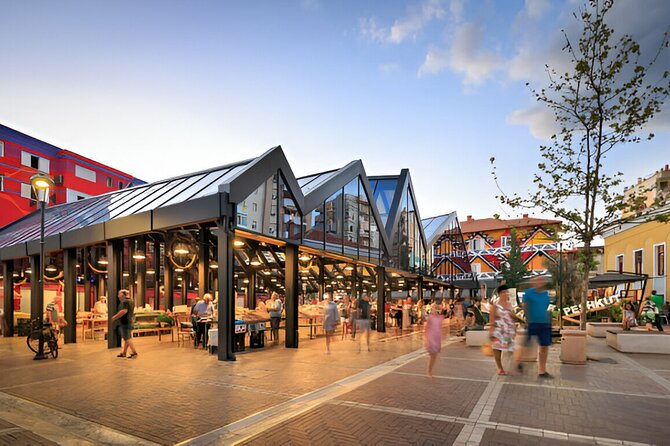
Pazari i Ri, or New Bazaar, brings the tour into present-day Tirana. The neighborhood is one of the city’s older residential areas, but it has been renovated with a fresher look while retaining traditional elements.
At its center is a farmers’ market where producers from surrounding areas sell fruit, vegetables, meat, seafood, spices, and other food. The market is useful for seeing how local commerce works, not just for taking photographs.
The scheduled visit is about 30 minutes. That is enough to walk through the area and get a feel for its food culture, but it is not enough for a long meal or extensive shopping. If you want to return for lunch, make a note of the area and come back after the tour.
This stop helps balance the historical material. You see that Tirana is not only a city of old buildings and painful memories. It is also a place where people shop, eat, meet, and maintain local routines in a changing urban setting.
Tanners’ Bridge and Tirana’s Ottoman trace
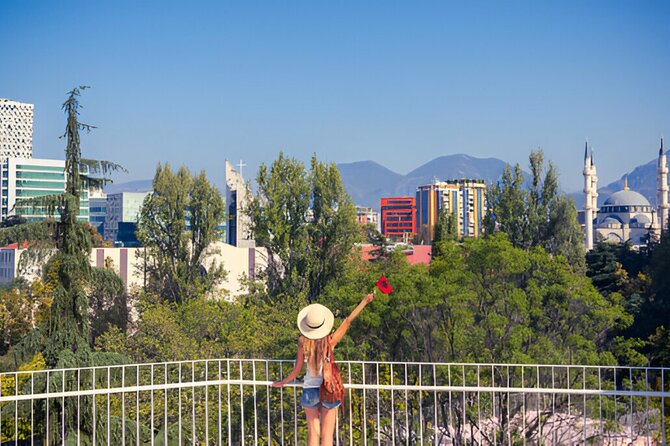
The Tanners’ Bridge is a small but useful stop. Built in the 1700s during Ottoman rule, this stone bridge now looks slightly out of place among modern streets.
Only about 10 minutes are allowed here. That is appropriate. The bridge is not a large monument with rooms to explore, but it gives you a quick visual clue about the city before modern roads and buildings covered much of its older form.
I like stops such as this when they are kept brief. You do not need a long lecture to understand the point. The bridge shows that Tirana’s past is not confined to major museums. Small fragments survive in ordinary parts of the city, sometimes surrounded by traffic and newer construction.
The Pyramid and the Postbllok memorial
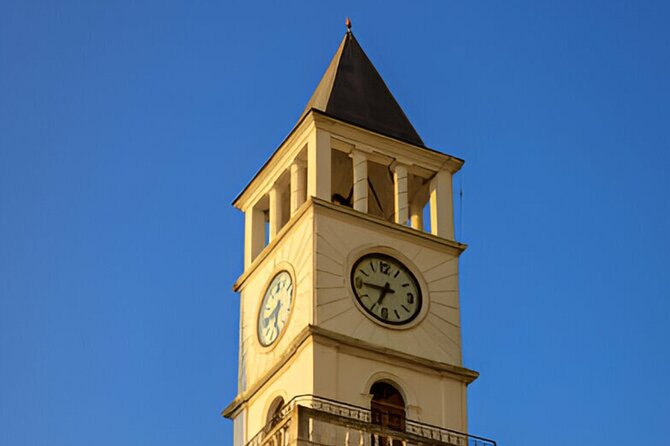
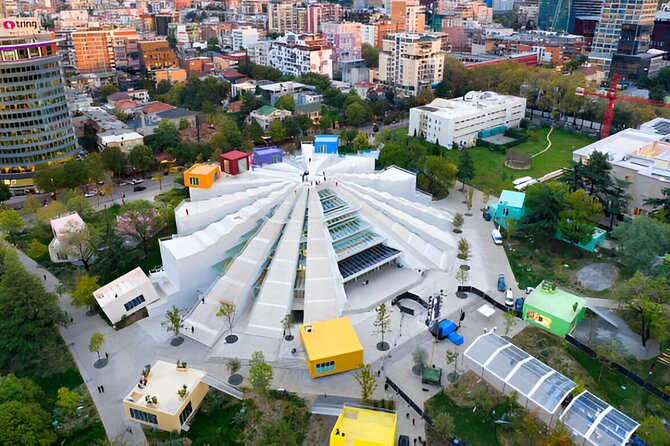
The Pyramid of Tirana is one of the city’s most curious buildings. It was created as a museum dedicated to communist leader Enver Hoxha shortly before communism fell. Later, it served different purposes, including use as a NATO base during the Kosovo War.
The building has been undergoing work to become a youth cultural center, so its appearance and access may change. The planned visit is around 15 minutes. You should think of this as an exterior and historical explanation rather than a guaranteed full interior tour.
The Pyramid works especially well after House of Leaves. At the museum, you see the state’s surveillance system from the inside. At the Pyramid, you see how a monument to dictatorship can acquire new meaning after political change.
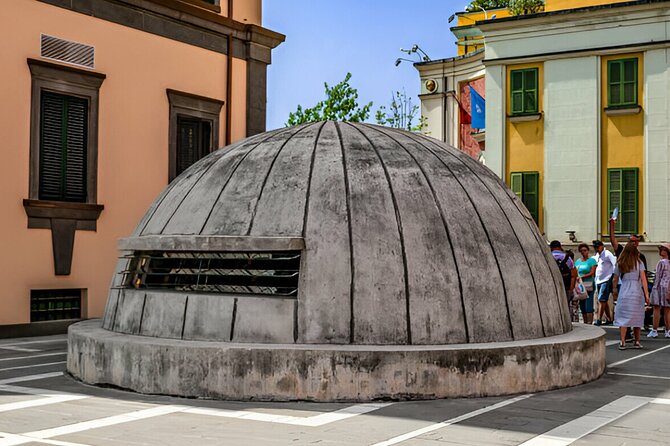
Postbllok, also called the Checkpoint Monument, adds another sober reminder of the communist period. The memorial includes concrete girders taken from Spaç Prison, where political prisoners were held. Lined up as they once were in the prison halls, the pieces make repression feel physical and industrial.
The visit is listed at about 20 minutes. That is long enough for your guide to explain the memorial and its connection to prison life. This is not a cheerful photo stop, but it is an important one, especially if Albania’s recent history is a main reason for visiting Tirana.
FAB Gallery and young Albanian art
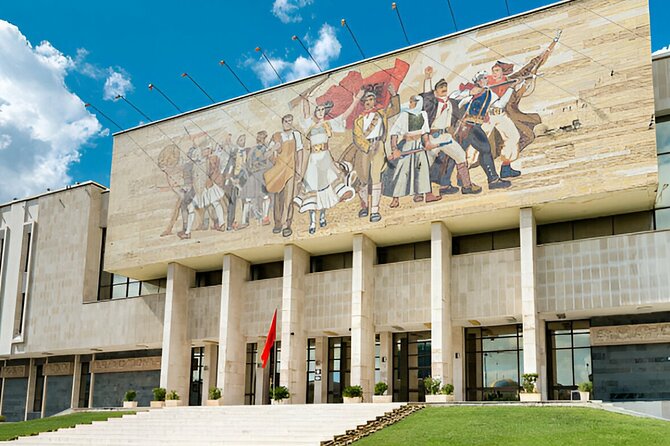
The FAB Gallery is connected to the University of Arts in Tirana and is located at Mother Teresa Square. Its program mainly supports students and young artists through painting, photography, and occasional short films.
Exhibitions can change frequently, sometimes from one week to the next. Entry is usually free, according to the supplied details, but the content and opening conditions can vary with the current event.
The planned visit is about 30 minutes. The gallery may show colorful abstract work and graffiti-style pieces, giving you a look at the city’s newer art scene after the historical weight of House of Leaves and Postbllok.
I like including a working student gallery in a city tour. It avoids treating Albanian culture as something locked in the past. Still, you should keep expectations flexible. A small gallery with a changing program will not offer the same predictable experience as a permanent museum.
Is $58.18 fair for four hours?
At $58.18 per person, this is not the cheapest way to walk around Tirana. You can see Skanderbeg Square, the New Bazaar, the Tanners’ Bridge, and several exterior landmarks without paying for a tour.
The value comes from the interpretation and the included admissions. House of Leaves and Sali Shijaku Villa are the key paid cultural stops, and the tour links them to the mosque, cathedral, Pyramid, memorials, and art gallery. You are paying for a guide to explain how those pieces fit together.
The maximum group size is 10. That is a meaningful advantage at this price. A small group makes it easier to hear explanations, ask about Albania’s communist era, and manage a route with several short visits.
This price makes the most sense if you have limited time in Tirana or want a structured introduction on your first day. It is less compelling if you prefer to explore slowly, spend hours in one museum, or visit the market mainly for a meal.
The experience has free cancellation up to 24 hours before the start time. Changes or cancellations made within 24 hours are not refundable, so keep that deadline in mind when arranging your plans.
Timing, walking, and practical expectations
The tour lasts about four hours and begins at Skanderbeg Square. It ends back at the same meeting point, which is convenient if you want to continue exploring central Tirana afterward.
The operating hours supplied for this experience are 9 a.m. to 5 p.m., Monday through Sunday, from June 19, 2024, through June 18, 2026. The tour begins at the stated meeting point, but confirm your exact start time when booking.
You should expect a city walk with several short stops. The route includes museums, religious buildings, monuments, a gallery, a market district, and a historic bridge. Wear shoes suited to pavement and be ready for some time on your feet.
The activity uses a mobile ticket. Confirmation is provided when you book, and the tour is near public transportation. Service animals are allowed, and most people can participate. It is not recommended for people over 95.
Access can change at individual sites. One account of the experience notes that some places were closed, but the tour continued for the full planned duration. That tells you to value the guide’s flexibility, while also reminding you that no four-hour city route can guarantee every interior visit.
Who should choose this cultural tour?
I would choose it for a first visit to Tirana, especially if you want history, art, architecture, and everyday city life in one morning or afternoon.
It suits you particularly well if:
- You want a serious look at Albania’s communist period.
- You prefer a small group to a large coach tour.
- You want House of Leaves included rather than having to organize it alone.
- You enjoy mixing major landmarks with a private art house and local market.
- You have only a short stay and need a useful orientation.
It may not suit you if you want a relaxed food tour, a specialist art tour, or a single museum explored at length. The schedule moves steadily, and the number of stops means each one receives a limited amount of time.
Guide Gjuljana is identified as an especially passionate and well-informed guide for this experience. If she is leading your departure, expect strong explanations and an engaged approach. The guide’s skill matters here because the route’s real value comes from connecting separate sights into one story.
Should you book it?
Book this tour if you want Tirana explained rather than simply photographed. The House of Leaves, Postbllok memorial, and Pyramid give the route a serious historical spine, while Sali Shijaku Villa, FAB Gallery, and New Bazaar add art and daily life.
At $58.18, it is best value for a first-time visitor with limited time who appreciates included admissions and a small group. Skip it if you already know central Tirana well or want to set your own pace inside each site.
For most first visits, I would book it early, with an average booking lead time of about 14 days, and confirm which stops are open on your chosen date.
FAQ
Where does the Tirana cultural tour start?
It starts at Skanderbeg Square, Sheshi Skënderbej, in Tirana, Albania.
Where does the tour finish?
The activity ends back at the starting meeting point in Skanderbeg Square.
How long does the tour last?
The tour lasts approximately four hours.
How much does the experience cost?
The listed price is $58.18 per person.
Is House of Leaves included?
Yes. Admission to House of Leaves is included, with about one hour planned for the visit.
How large is the tour group?
The activity has a maximum of 10 travelers.
Does the tour include the Clock Tower?
The overview includes an ascent of Tirana’s Clock Tower for city views. The detailed stop schedule does not give it a separate time allocation, so confirm the exact plan when booking.
Can I cancel for a full refund?
Yes. You can cancel at least 24 hours before the start time for a full refund. Cancellations within 24 hours are not refundable.
Is the tour accessible by public transportation?
Yes. The meeting area is near public transportation. Service animals are allowed, and most people can participate.
Just added around Tirana
- UNESCO heritage in Albania – 4 days★ 5.0 · 3 reviews
- Apollonia and Berat UNESCO tour from Tirana★ 5.0 · 3 reviews
- Private Transfers from Tirana International Airport to Sarandë★ 4.5 · 3 reviews
- Transfers Tirana Airport – Sarande – Ksamil – Airport Tirana★ 4.5 · 3 reviews
- Berat 4×4 Off-Road and Vineyard Wine Tasting★ 5.0 · 3 reviews
- N. Macedonia &Kosovo; Semi – Private Tour; Tour Leader & Car★ 4.8 · 3 reviews
- Tirana to Ksamil and Saranda Bus★ 4.5 · 3 reviews
- SOTIRA WATERFALL HIKING/TREKKING from Berat by 1001 Albanian Adventures★ 5.0 · 3 reviews
Tirana Tours, compared.

Hike Gamti Mountain with Bovilla lake view & canyon- From Tirana
Read our review →
Berat city UNESCO tour, the Castle & Belshi lake- From Tirana
Read our review →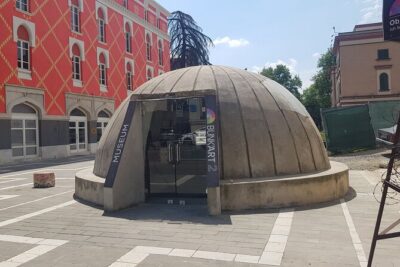
Kruja castle, the old Bazaar & Sarisalltik- Departure from Tirana
Read our review →
Albanian Night Show: Traditional Music, Dance & Dinner in Tirana
Read our review →
From Tirana- Hiking Tour to Bovilla Lake & Gamti Mountain
Read our review →
Shala river & Komani lake -Day trip departure from Tirana/Shkodra
Read our review →
Cooking Classes and Traditional food tasting in Tirana
Read our review →Browse the lists this tour appears in