
Reviewed · COMMUNIST HISTORY TOURS
The truest face of Communism
Tirana’s communist past is not tucked away in a distant museum. It is built into the city’s main square, its grand boulevard, its former political quarter, and a vast underground bunker. This tour connects those places with the stories that make them understandable, especially at Bunk’Art 1, where Albania’s isolation becomes physical.
I like the mix of famous sights and harder history. I also like that guides such as Leo, Dio, Aldo, and Eni have brought personal family stories into the discussion, rather than relying only on dates and political slogans. The included coffee, rakia, and traditional food stop add a welcome local touch.
The main thing to clarify before booking is the transport. The tour includes an air-conditioned vehicle and hotel pickup, but one booking party reported walking nearly five miles instead. If long walks are a concern, confirm the day’s plan in advance.
Key points at a glance
- Bunk’Art 1 is the main event: Explore nearly 3,000 square meters of underground rooms built to protect Albania’s communist elite from a nuclear attack.
- The tour links symbols to daily life: See the Pyramid, a bunker, Berlin Wall fragments, the former elite district, and Hoxha’s villa.
- Your guide shapes the experience: Leo, Dio, Aldo, Eni, Mimi, and DC have all been praised for clear English, warmth, and personal stories.
- Blloku reveals the sharpest contrast: The once-secret quarter for communist leaders is now filled with cafés, shops, bars, and street art.
- Local drinks and food are part of the stop: Coffee or tea, rakia, and traditional food near Blloku are included, but lunch is not.
- Plan for a half-day with some walking: The scheduled duration is four to five hours, and the route may involve more walking than the vehicle description suggests.
Why this Tirana history tour works
Albania’s communist period can be difficult to grasp from ordinary sightseeing. Enver Hoxha ruled the country from 1944 until his death in 1985, and his government pushed Albania into severe political isolation. The result was a capital filled with curious contradictions: monumental public buildings, thousands of concrete bunkers, a restricted neighborhood for the ruling class, and museums housed in places designed for secrecy.
This tour gives you a useful route through those contradictions. You begin at Skanderbeg Square, move past the Pyramid and a memorial to political isolation, pass through Blloku, and finish at Bunk’Art 1. The order works well because you first see the public face of power, then the private world of the party elite, and finally the hidden machinery of the regime.
Your guide matters a great deal here. The most warmly praised guides have included Leo, Dio, Aldo, and Eni, with Mimi and DC also receiving strong approval. Their role is not just to point at buildings. A personal account of how a family lived under communism can make the subject far more immediate than a museum label.
The tour is offered in English and is designed as a private activity for your group. That should give you more room to ask questions than a large coach excursion. Still, one account describes a small group and nearly five miles on foot, so the exact arrangement may vary. Ask about vehicle use and walking distance before you set out.
More bunker and communist-era tours:
- A Communist Manifesto: Tirana before and after
★ 5.0 · 50 reviews - Full-Day Tour of Albania’s Bunkers and Beaches, from Tirana
★ 5.0 · 16 reviews - Communist History Tour Tirana & Street Food
★ 5.0 · 15 reviews
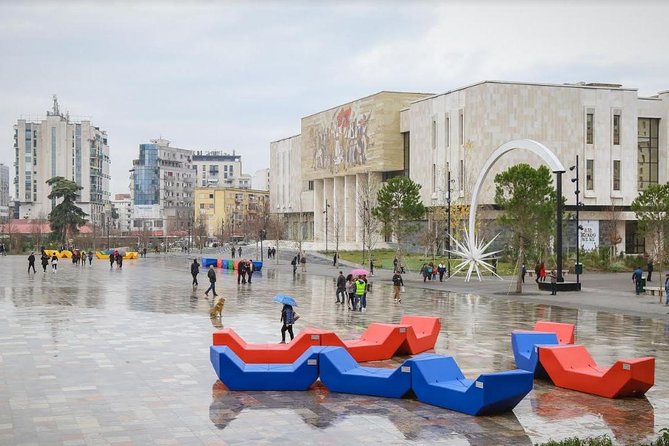
Skanderbeg Square and the public face of Tirana
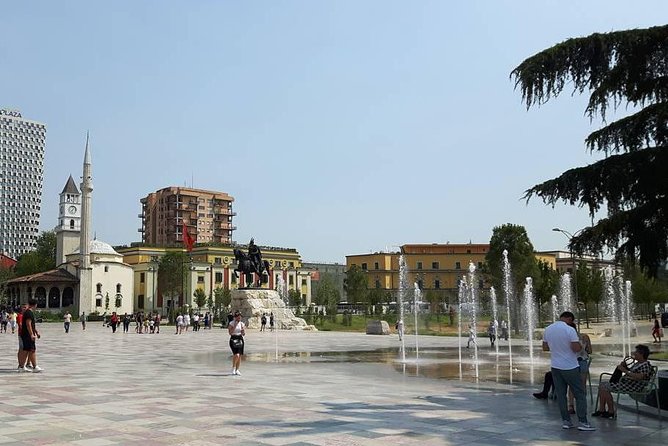
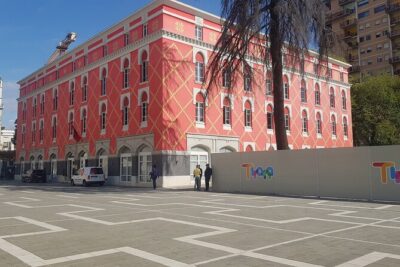
The tour starts at Skanderbeg Square at 9:00 a.m., with pickup also available from a hotel, hostel, or agreed departure point in Tirana. This central square is the right place to begin because so many layers of the capital meet here.
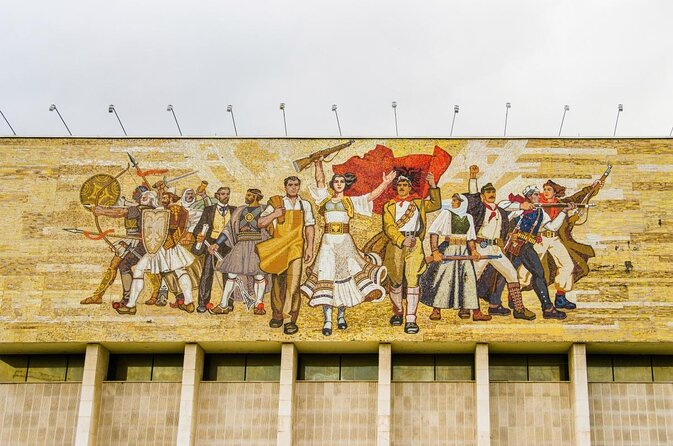
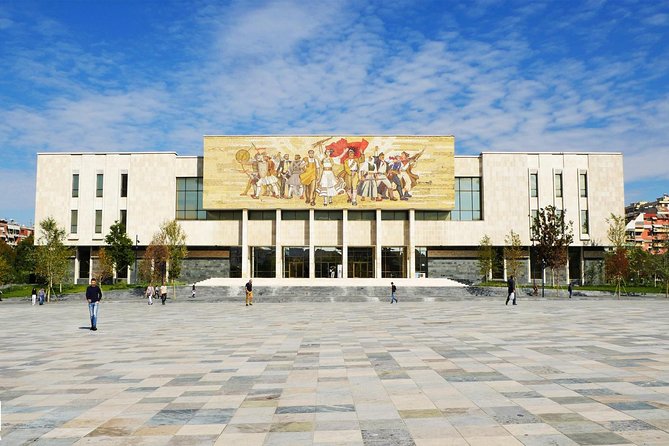
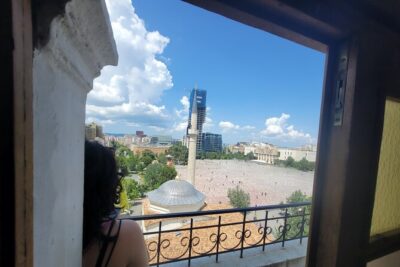
You’ll see the Et’hem Bey Mosque, the Clock Tower, the National Bank of Albania, the National Theatre of Opera and Ballet, and the Tirana International Hotel. The square is not only a collection of landmarks. It shows how successive governments used architecture to project order, modernity, and political purpose.
The Opera and Ballet building has its own Cold War detail: the first brick was placed by Nikita Khrushchev, the former Soviet leader. That small fact helps explain Albania’s early ties with the Soviet Union before Hoxha broke away from Moscow and pushed the country toward even greater isolation.
Allow about 30 minutes here. Admission is free, and the value comes from the guide’s explanation. Without context, the square can seem like a standard city center. With a good guide, it becomes a primer for understanding Albania’s shifting alliances and the way political power shaped Tirana.
The Pyramid of Enver Hoxha
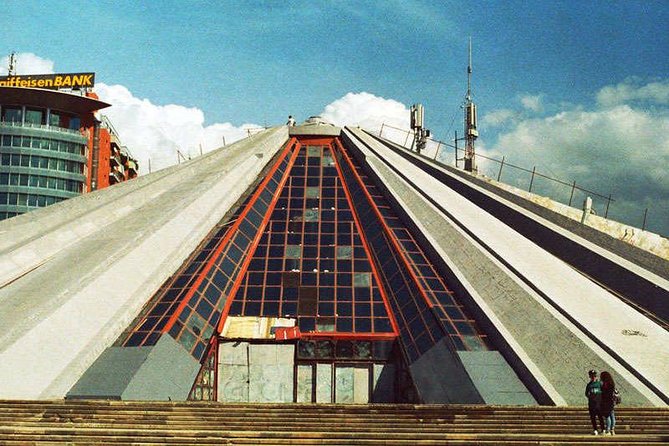
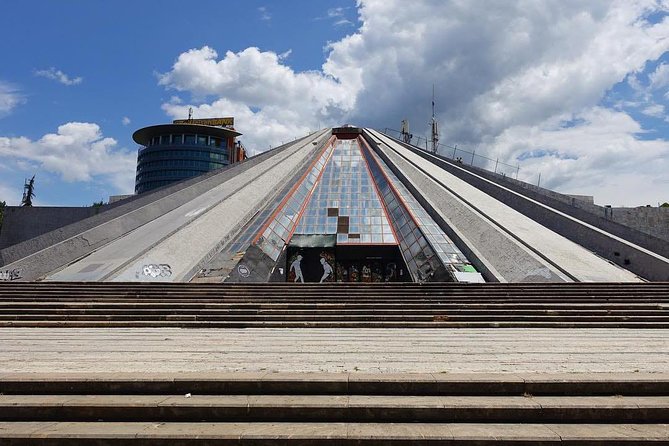
The Pyramid receives a short stop of about 15 minutes, but it carries a lot of political weight. Built as a museum dedicated to Enver Hoxha, it opened in 1988, three years after his death. Hoxha’s daughter helped design it, adding another layer to the building’s connection with the ruling family.
The original purpose was almost mausoleum-like: to honor the leader of the Communist Party and First Secretary of the Party of Labor. After communism fell, the building served several other roles, including a cultural center and a television office. It also survived a proposal for demolition.
From the outside, the Pyramid is an excellent symbol of Albania’s uneasy relationship with its past. It is too politically charged to ignore, yet too useful and recognizable to erase. The short stop is enough to explain its purpose and later uses, though you should not expect an extended interior visit based on the published schedule.
Postbllok and three pieces of political memory
Postbllok, also called the Checkpoint Monument, takes about 10 minutes. It is a compact memorial, but its three parts tell a large story.
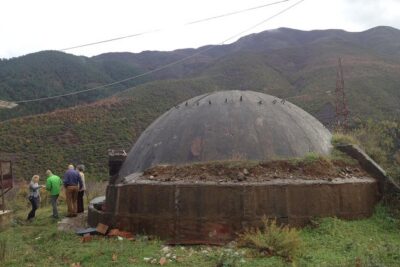
One element is a concrete bunker. Albania’s former government built thousands of bunkers across the country, with the plan that each family would have protection during a nuclear or global war. The bunkers never served the purpose promised by the regime, but they remain one of the most visible signs of its fear and isolation.
The memorial also includes concrete supports from the Spaç labor camp, where political prisoners suffered between 1968 and 1990. These are not decorative ruins. They connect the polished center of Tirana with a penal system that many visitors would otherwise find hard to picture.
The third piece is a brightly painted section of the Berlin Wall from Potsdamer Platz. Its presence links Albania’s experience to the wider division of Cold War Europe. I find this stop especially useful because it is brief and direct. You can see, in one place, military fear, forced labor, and the wider political split of the continent.
A few more Tirana half-days to weigh up
- Hike Gamti Mountain with Bovilla lake view & canyon- From Tirana
★ 5.0 · 1,280 reviews - Berat city UNESCO tour, the Castle & Belshi lake- From Tirana
★ 5.0 · 804 reviews - Walking Tour of Tirana
★ 5.0 · 646 reviews - Kruja castle, the old Bazaar & Sarisalltik- Departure from Tirana
★ 5.0 · 592 reviews
Blloku, from secret party quarter to café district
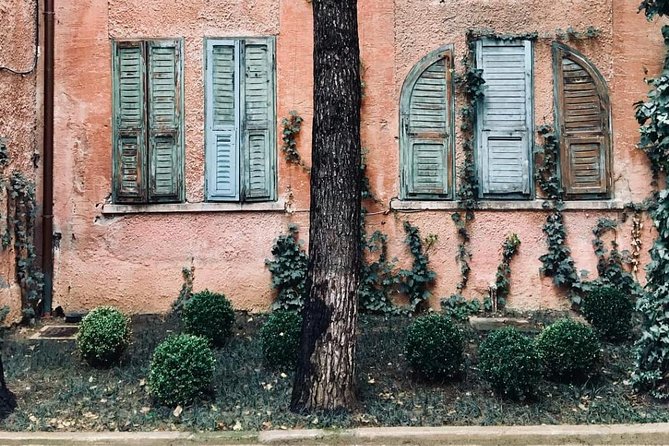
Blloku offers the tour’s sharpest change in mood. Under communism, this neighborhood was reserved for the political bureau and senior party officials. It was absent from ordinary maps, and most Albanians could not simply wander in.
Today, Blloku is one of Tirana’s most active areas, with boutiques, coffee shops, cocktail bars, pubs, and street art. The contrast is not subtle, and that is exactly why the stop works. You are looking at a district once protected by secrecy and privilege, now used as a social center for the wider city.
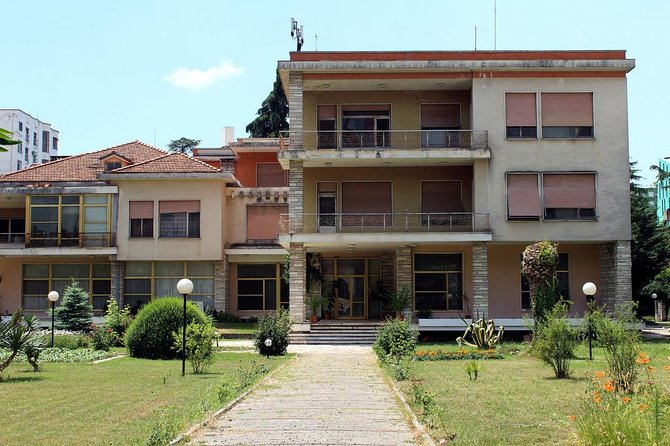
The former villa of Enver Hoxha is here. You can see it from outside, but entry is not allowed. That limitation is worth knowing before you arrive. The villa is not a house museum with furnished rooms and a guided interior visit. Its importance comes from its location and from what it represents: the gap between the controlled life of ordinary Albanians and the protected life of the ruling class.
The scheduled stop lasts about 50 minutes, making it the longest pause before the bunker museum. Coffee, tea, rakia, and traditional food are included at a nearby restaurant. Byrek has been part of the food experience, and rakia is offered as a traditional Albanian drink. It is strong, so a small glass is sensible if you still have a museum visit ahead.
Lunch is not included. The Blloku stop may provide a snack or traditional dish, but you should budget separately for a full meal. One account praised the lunch highly, so the exact food arrangement may depend on the day, the group, or the restaurant. Ask your guide what is planned if eating a proper lunch matters to you.
Bunk’Art 1, the tour’s strongest stop
Bunk’Art 1 is where the subject becomes most tangible. The museum occupies nearly 3,000 square meters of underground rooms, corridors, and chambers spread across several levels. Built in the 1970s, it remained secret for much of its existence.
The bunker was designed to survive a nuclear attack. Its double-concrete walls and underground layout were meant to protect more than 100 people, including members of the political elite. The attack never came, leaving behind a huge, sealed world created for a crisis that did not happen.
Expect about an hour here. The route through the bunker is labyrinth-like, and that physical quality is part of the experience. You are not simply reading about isolation. You are moving through narrow passages and rooms built around the assumption that Albania might be cut off from the outside world at any moment.
The museum contains fragments of communist-era history in rooms that once had practical military or political uses. A guide adds real value here because the labels alone cannot always explain how the spaces fit together. Several guides have been praised for walking people through the displays and explaining the period in plain English.
This is also the stop most likely to stay with you after the tour. The Pyramid is an obvious political symbol, while Bunk’Art 1 lets you feel the scale of the state’s fear and preparation. The bunker was built for the elite, but the tour also helps connect it to the wider hardship experienced by ordinary Albanians.
Guides, group size, and the walking question
The tour is sold as private, with only your group participating. That format is useful for a subject that can prompt sensitive questions. You can stop to ask how a particular policy affected families, religion, work, travel, or daily life without waiting for a large group to catch up.
Named guides praised in the supplied material include Leo, Dio, Aldo, and Eni. Leo has been described as polite, personal, and careful with the group. Dio has been singled out for his English and command of Albanian history. Aldo brought family stories into the discussion, while Eni was praised for making each place engaging and for sharing a personal account. Mimi and DC were also credited with being helpful and willing to handle extra requests.
That does not mean you are guaranteed a particular guide. It does tell you what to look for: a guide who explains the political background, answers questions, and adds lived context rather than rushing from monument to monument.
The transport description needs a little care. An air-conditioned vehicle and hotel pickup are included, but one booking party found the day was entirely on foot and covered nearly five miles. The published route itself includes several central stops, and the amount of walking can affect how comfortable the half-day feels. Contact the operator before booking if you need regular vehicle transfers or have limited mobility.
Price, timing, and who gets good value
At $90.11 per person, this is not the cheapest way to see central Tirana. It is a better value for people who want interpretation, hotel pickup, entrance fees, and a private guide rather than a quick list of landmarks.
The price includes all fees and taxes, coffee or tea, rakia, traditional food at the Blloku stop, and hotel pickup in Tirana. Lunch is extra. The duration is roughly four to five hours, so you still have time afterward for your own lunch, shopping, or another museum.
The value improves if you have only a short stay in the capital. One person with 48 hours in Tirana found the tour a useful way to understand the city’s political past quickly. I agree with that logic. You see the center, the former elite quarter, and Bunk’Art 1 in one morning instead of trying to piece the story together alone.
The value is less clear if you only want general sightseeing or prefer to wander at your own pace. The communist subject shapes the entire morning, and Bunk’Art 1 involves underground rooms and corridors. It is best suited to people who want a serious look at Albania’s recent past, not just a photo tour of Tirana.
The experience is available in English, and confirmation arrives at booking. Most people can participate, service animals are allowed, and the meeting point is near public transportation. Free cancellation is available up to 24 hours before the start time. Poor weather can lead to a different date or a full refund, since the tour requires good conditions.
Should you book The Truest Face of Communism?
Book it if you want Tirana’s monuments to make sense. The combination of Skanderbeg Square, the Pyramid, Postbllok, Blloku, and Bunk’Art 1 gives you a clear route through the capital’s communist story, while a strong guide can add the personal details that museums often lack.
I would give special weight to Bunk’Art 1 and to the guide when making your decision. The bunker is the most memorable part, and the best guides, including Leo, Dio, Aldo, and Eni, have been praised for clear English, friendly care, and personal stories.
Before paying, confirm two practical points: how much of the route will use the vehicle, and what food is included at Blloku. If you are comfortable with possible walking and want a focused, thoughtful morning in Tirana, the $90.11 price is reasonable for a private experience with admissions, pickup, drinks, and local food included.
FAQ
How long does the tour last?
The experience lasts approximately four to five hours.
What time does the tour start?
The scheduled start time is 9:00 a.m.
Where does the tour begin?
The listed meeting point is Skanderbeg Square in Tirana. Pickup is also offered from your hotel, hostel, or another agreed departure point in Tirana.
Is the tour private?
Yes. It is described as a private activity, with only your group participating.
What language is offered?
The tour is offered in English.
Is Bunk’Art 1 included?
Yes. Admission to Bunk’Art 1 is included, and the visit is scheduled for about one hour.
Are food and drinks included?
Coffee or tea, alcoholic beverages including rakia, and traditional food at a restaurant near Blloku are included. Lunch is not included.
Can I cancel for a full refund?
Yes, if you cancel at least 24 hours before the experience start time. Cancellations or changes made less than 24 hours before the start are not refunded. If poor weather causes the operator to cancel, you will be offered another date or a full refund.
Just added around Tirana
- UNESCO heritage in Albania – 4 days★ 5.0 · 3 reviews
- Apollonia and Berat UNESCO tour from Tirana★ 5.0 · 3 reviews
- Private Transfers from Tirana International Airport to Sarandë★ 4.5 · 3 reviews
- Transfers Tirana Airport – Sarande – Ksamil – Airport Tirana★ 4.5 · 3 reviews
- Berat 4×4 Off-Road and Vineyard Wine Tasting★ 5.0 · 3 reviews
- N. Macedonia &Kosovo; Semi – Private Tour; Tour Leader & Car★ 4.8 · 3 reviews
- Cultural Tour in Tirana including House of Leaves★ 5.0 · 3 reviews
- Tirana to Ksamil and Saranda Bus★ 4.5 · 3 reviews
Communist History Tours, compared.
Full-Day Tour of Albania’s Bunkers and Beaches, from Tirana
Read our review →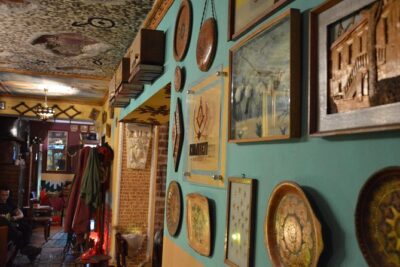
Tirana’s Communist Past: A Tasting Tour with Traditional Lunch
Read our review →Browse the lists this tour appears in